
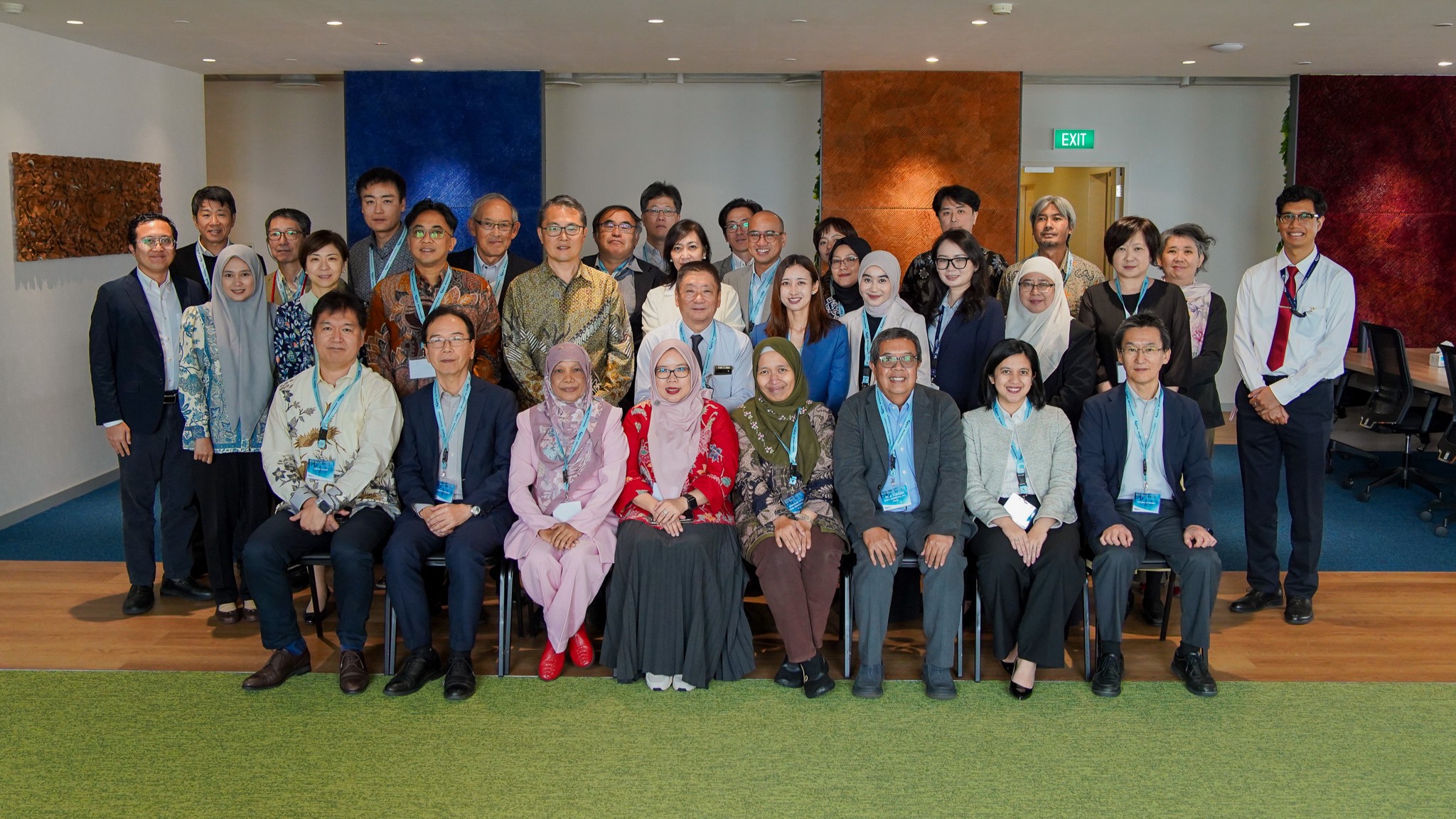
ERIA School of Government Hosts Inaugural ERIA Collaborative Partnership Forum on Biomanufacturing
Jakarta, 31 October 2025: The ERIA School of Government successfully hosted the Inaugural ERIA Collaborative Partnership Forum on Biomanufacturing, supported by the Asia-Pacific Research Center (APRC). Building on the momentum of the 2nd ERIA–APRC Research Exchange and Innovation Workshop on Biomanufacturing held the previous day, the forum extended the academic dialogue into collaborative discussions with industry and policymakers.
The forum aimed to foster dialogue and strengthen academic–industry partnerships between Japan and ASEAN, promoting joint research and collaboration. It also provided researchers with opportunities to scale up their work and connect scientific innovation with practical applications.
In his opening remarks, Professor Nobuhiro Aizawa, Dean and Managing Director of the ERIA School of Government, reflected on the previous day’s presentations and praised the innovative ideas shared by participants. He emphasised the vital role of collaboration in transforming research into real-world solutions.
Mr Shinichi Kuroki, Deputy Director-General of the APRC, highlighted the forum’s role in strengthening co-operation between researchers and industry leaders. He noted that the discussions sought to advance industrialisation through biofuels derived from seaweed and palm oil, as well as other emerging innovations. He further encouraged participants to move beyond research and establish practical manufacturing collaborations between science and industry.
Similar to the previous workshop, this forum focused on the strategic biomanufacturing fields of palm oil and seaweed, exploring opportunities for scaling up and showcasing innovations. The palm oil session explored developments such as palm oil-derived diesel fuel, bioethanol, anti-corrosion products, fibres, and vanillin extraction. The seaweed session featured research on high-value seaweed products, carbon capture, cultivation infrastructure, cosmetics, and value-added foods. An innovation session spotlighted industrial applications in food printing, microalgae, metabolomics, and carbon cultivation, while a session focused on scaling biomanufacturing featured industry perspectives on intellectual property, seaweed, and cell-based biomanufacturing.
Participants actively exchanged insights on challenges, opportunities, and societal implications, laying the groundwork for deeper cross-sectoral collaboration between ASEAN and Japan.
This forum aligns with Japan’s Bioeconomy Strategy (2019), which envisions a sustainable, innovation-driven ecosystem by 2030, and ASEAN’s commitment to promoting science and technology collaboration. Through this initiative, ERIA reaffirmed its dedication to advancing international research co-operation and strengthening ties amongst academia, industry, and policymakers through the ERIA School of Government.


